If you own a luxury home in The Landings, one pricing mistake can cost you months of momentum. In this part of Fort Lauderdale, broad neighborhood averages often miss what buyers are actually paying for, especially on waterfront properties. The good news is that with the right pricing strategy, you can position your home to attract serious attention without leaving value on the table. Let’s dive in.
Why average pricing fails in The Landings
At first glance, neighborhood data can look confusing. In March 2026, Redfin showed a Landings median sale price of $520,000, but that snapshot blended very different property types and reflected very low sales volume. For a luxury waterfront seller, that kind of median is not a reliable guide.
The Landings includes a mix of condos, dry-lot homes, and waterfront properties with very different boating utility. When those categories get lumped together, the result can hide a price spread of well over $1 million. That is why strategic pricing here starts with micro-market analysis, not neighborhood averages.
What buyers are really paying for
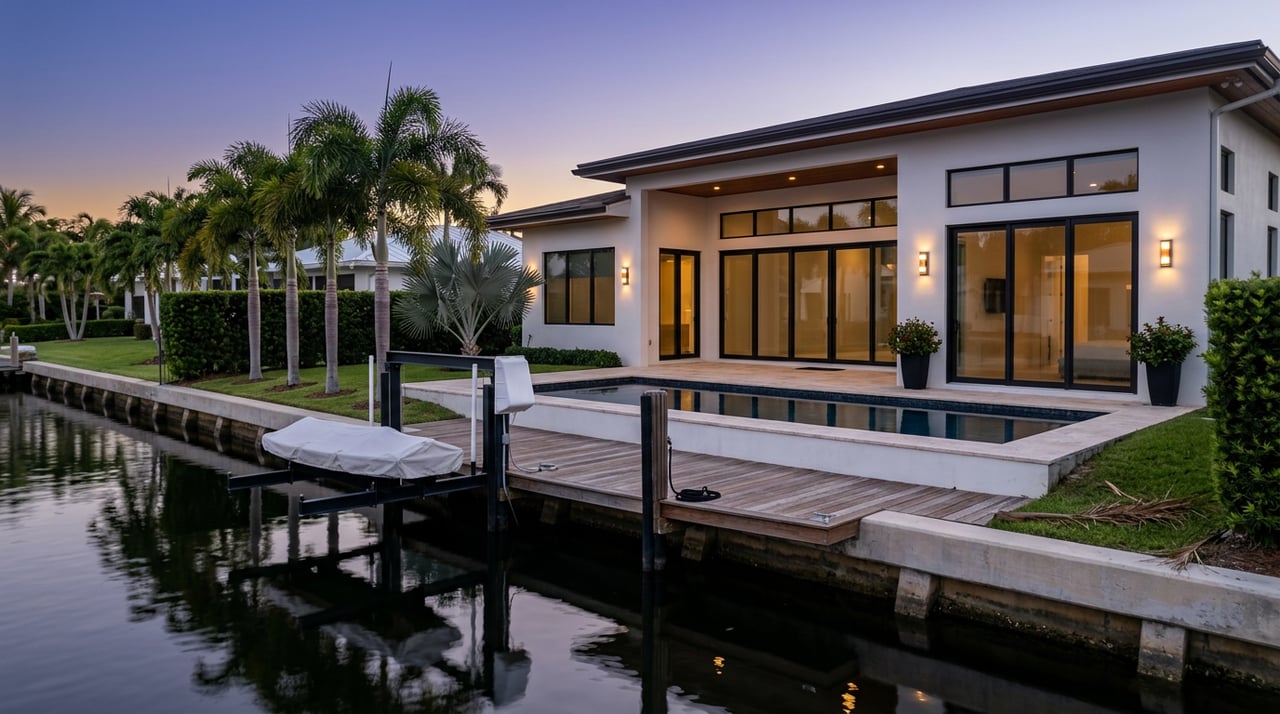
Luxury buyers in The Landings are not just buying a house. They are comparing water access, lot geometry, dock usability, bridge clearance, and overall condition. In many cases, those factors have more influence on price than square footage alone.
That matters because two homes in the same neighborhood can live in very different value tiers. A renovated home with fixed-bridge access may compete in a different band than a less updated property with no fixed bridges and better boating utility. In this market, details drive pricing.
Waterfront geometry matters
Recent sales in and around The Landings show that waterfront position can change value dramatically. A point lot, wider frontage, or better turning room can place a property in a higher pricing band even before condition is considered.
For example, 5201 NE 32 Ave sold for $3.7 million with roughly 263 feet of frontage and unobstructed ocean access. Another sale, 3200 NE 56th Ct, closed at $2.8 million and stood out for its point lot position, oversized turning basin, T canal location, and no fixed bridges. Those features tell you that buyers are paying a premium for water utility, not just waterfront presence.
Bridge count and ocean access shape demand
Not all waterfront is equal in the eyes of a boating buyer. Properties with no fixed bridges often appeal to a broader luxury buyer pool than homes with bridge restrictions. That difference can show up clearly in final sale price.
A good example is 2911 NE 55th St, which sold for $2.0 million with 76 feet of frontage and a renovated interior, but had fixed-bridge access. By contrast, 5552 NE 31st Ave also sold for $2.0 million and offered no fixed bridges, a wide lagoon, and a substantial dock, even though it still closed well below its initial ask. The takeaway is simple: access affects value, but the asking price still has to match buyer expectations.
Dock usability is part of the price
In The Landings, a dock is not just an amenity. Buyers look closely at dock length, seawall condition, turning room, and the type of boat the property can realistically accommodate. Those features often shape how a buyer compares one home to another.
Recent listing remarks consistently highlighted dock dimensions, seawalls, bridge clearance, and marina-style functionality. That tells you buyers are underwriting boating convenience as part of the property’s value. If your home offers strong dock utility, that should be reflected in pricing and presentation, but not overstated.
Renovations help, but they do not erase location differences
Upgrades matter in the luxury segment, especially when they reduce friction for a buyer. Impact glass, updated kitchens, newer roofs, and improved docks can all strengthen value. Still, buyers do not always pay dollar-for-dollar for renovations.
That pattern showed up in recent sales. The renovated 2911 NE 55th St sold for $2.0 million after being listed at $2.688 million, while 5552 NE 31st Ave closed at $2.0 million after initial asks around $2.675 million to $2.688 million despite notable improvements like a 2021 dock, a 2015 tile roof, and impact glass. In other words, upgrades can support pricing, but they do not automatically justify an aspirational launch.
Recent pricing bands in The Landings
A better way to think about pricing is to sort homes into logical waterfront categories. Recent sales suggest a range that looks more nuanced than the neighborhood median implies.
- Top-of-band reference: 5201 NE 32 Ave at $3.7 million for a point lot with approximately 263 feet of frontage and ocean access
- Strong premium waterfront reference: 3200 NE 56th Ct at $2.8 million for a point lot with turning basin utility and no fixed bridges
- Improved boating-property reference: 5500 NE 31st Ave at $2.7 million with a rebuilt home, seawall, extended dock, and room for a 35-foot boat
- Mid-band no-fixed-bridge waterfront reference: 5552 NE 31st Ave at $2.0 million with wide lagoon positioning and substantial dock improvements
- Fixed-bridge renovated waterfront reference: 2911 NE 55th St at $2.0 million with updated interiors but different boating utility
- Nearby dry-lot baseline: east Fort Lauderdale references at $915,000 and $700,000, useful only as a non-waterfront comparison point
The gap between these sales is the key lesson. If you price a point-lot waterfront home using blended neighborhood data, you may underprice it. If you price a fixed-bridge or average canal-front home as though all waterfront carries the same premium, you may lose valuable time on market.
Why realistic pricing matters right now
The broader Broward single-family market remained active in Q1 2026, but it was not effortless. Countywide months' supply was 4.8, and Fort Lauderdale was at 6.9 months' supply. Sellers received 94.7% of original list price countywide and 93.6% in Fort Lauderdale.
That tells you buyers are active, but selective. It also suggests that overpricing can reduce leverage rather than create it. In Fort Lauderdale, the median time to contract was 69 days, which is another sign that launch strategy matters.
At the luxury level, demand is still present. Broward’s single-family luxury threshold reached $2.3 million in Q1 2026, and ultra-luxury rose to $6.2 million. The county also posted a 19.53% year-over-year increase in $1 million-and-up total home sales in February 2026, which confirms there are buyers, but they are comparing homes carefully.
How to price a luxury home strategically
The smartest pricing plans in The Landings usually begin with a comp stack, not a single comp. That means reviewing several relevant sales and sorting them by true competitive set.
A practical comp stack should separate:
- Dry-lot homes
- Fixed-bridge waterfront homes
- Protected lagoon properties
- Wide-canal homes with no fixed bridges
- Point-lot or turning-basin properties
This approach helps you identify where your home actually belongs in the market. It also keeps you from using the wrong benchmark, which is one of the fastest ways to miss the mark.
Start with utility, not just finishes
Luxury sellers often focus first on interiors, which is understandable. But in The Landings, buyers often assign value first to access, frontage, and boat usability. Finishes matter, but waterfront function usually sets the pricing framework.
That is why a polished presentation should support the fundamentals, not replace them. If your lot geometry or water access is exceptional, that may justify stronger pricing. If the home needs dock, seawall, roof, or interior updates, that should be built into the launch strategy from day one.
Price for the first wave of buyers
The first group of serious buyers is usually your best chance to test true market demand. These buyers are often the most informed and the quickest to recognize whether a home is priced correctly. If the property launches too high, they may move on and wait for a reduction.
In a market where many homes close below original list price, that first impression matters. Strategic pricing is not about being conservative for the sake of it. It is about entering the market at a level that invites confident action from the right buyer pool.
Plan ahead if you expect to sell in 6 to 18 months
If your sale is not immediate, now is the time to evaluate which improvements will actually support your future pricing. Recent sales suggest that updates can help, but only when they align with what buyers value most. For many waterfront homes, that may mean focusing on seawall condition, dock functionality, impact protection, or major deferred maintenance before cosmetic extras.
It also helps to watch how competing inventory is positioned. Because luxury pricing in The Landings is so segmented, small shifts in competing listings can influence how your home should be introduced later. A thoughtful plan today can protect your leverage when you are ready to launch.
The real pricing advantage is local interpretation
The Landings is the kind of market where a spreadsheet alone is not enough. You need to know why one waterfront sale pushed into the high $2 millions while another settled near $2 million, even with updates. The answer often comes down to how buyers interpret boating utility, lot characteristics, and overall ease of ownership.
That is where local, property-specific pricing becomes a true advantage. When your pricing reflects how qualified buyers actually compare homes in this pocket of Fort Lauderdale, you give your listing a stronger chance to stand out, hold attention, and sell with less friction.
If you are thinking about selling in The Landings and want a pricing strategy built around your home’s exact waterfront profile, condition, and buyer appeal, schedule a private consultation with Heather Lefka.
FAQs
What is the biggest pricing mistake for luxury homes in The Landings?
- The biggest mistake is relying on blended neighborhood averages that combine condos, dry-lot homes, and very different types of waterfront properties.
How should waterfront homes in The Landings be compared for pricing?
- Waterfront homes in The Landings should be grouped by features like bridge access, frontage, canal width, turning room, dock usability, and point-lot or lagoon positioning.
Do renovations raise value for Landings luxury homes?
- Yes, renovations can support value, especially updates like impact glass, roofing, kitchens, and docks, but recent sales show buyers do not always pay dollar-for-dollar for improvements.
Why does no-fixed-bridge access matter for Landings home values?
- No-fixed-bridge access can widen the buyer pool for boating-oriented purchasers, which may support stronger pricing than homes with bridge restrictions.
Is the Broward luxury market still active for sellers in 2026?
- Yes, the market remains active, with Broward’s luxury threshold at $2.3 million in Q1 2026 and a year-over-year increase in $1 million-and-up sales, but buyers are still selective and price-sensitive at launch.