Most of Fort Lauderdale experiences the Seminole Hard Rock Winterfest Boat Parade as a spectator sport. You claim a spot on the Intracoastal, you buy a ticket to the official viewing area, or you find a bar with a dock and a good sightline. For the people who live on the Las Olas Isles, the parade works differently. It doesn't arrive at your neighborhood. It moves through the same finger canals your paddleboard uses on a Tuesday morning, and for a few hours in December, that water stops behaving like a backyard and starts behaving like a route with a schedule, a staging area, and a bridge that won't open on its usual timetable.
That distinction, between watching a parade and hosting one in your own channel, is the thing worth understanding if you already live here. It also explains something residents figure out only after their first December on the isles: this waterway isn't a passive amenity. It's infrastructure that gets used, managed, and occasionally locked, and the parade is just the most visible night of the year that proves it.
Where the Parade Actually Goes
The 2026 Seminole Hard Rock Winterfest Boat Parade runs on Saturday, December 12, marking its 55th year. A pre-show of non-motorized vessels starts at 5:30 p.m., with the main parade underway at 6 p.m., a start time moved earlier than in past years. Boats stage along the New River, west of Stranahan House and down toward the Broward Center for the Performing Arts, before heading east on the river and turning north into the Intracoastal.
Between the New River and the Intracoastal sits the stretch that matters most if you live here: the boats pass directly through the Las Olas Isles canals before continuing north past Fort Lauderdale Beach and on to Lake Santa Barbara in Pompano Beach, a route of roughly 12 miles that takes about two and a half hours to watch in full from any single vantage point. That means isles residents catch the parade early in its run, well before it reaches the ticketed crowds waiting at the Intracoastal viewing area or the beachfront spectators further north. If you're on a dock in the isles, you're not watching the tail end of a long night. You're watching the parade at the point where it's still finding its rhythm.
The Bridge Doesn't Keep Its Usual Hours
Here's the detail that changes how you plan the evening if you own a boat. On a normal night, the Las Olas Boulevard bridge, the same one that connects the isles to the Intracoastal, opens on a set schedule: the quarter and three-quarter hour, twice an hour, for passing traffic. It's predictable enough that boaters on the isles plan trips around it without thinking too hard.
On parade night, the bridge doesn't follow that schedule. Organizers lock it open for the full duration of the event so the fleet can pass through uninterrupted, which means the bridge that normally cycles every thirty minutes becomes a fixed opening for hours at a stretch. If you're planning to head east that evening, whether to reach the ticketed viewing area or just to get to the beach side, the guidance from organizers is to be east of the bridge by 6 p.m., because once the parade locks it open, the normal rhythm doesn't resume until the last boat clears.
It's a small mechanical fact, but it's the kind of thing that only means something once you live on the water it affects. The isles aren't just a scenic backdrop to Winterfest. For one night, they're a working segment of the route, complete with a chokepoint that behaves nothing like the rest of the year.
Watching From Your Own Seawall vs. Everyone Else's Options
Residents on the isles have a choice most spectators don't: stay home. Here's how the options actually compare.
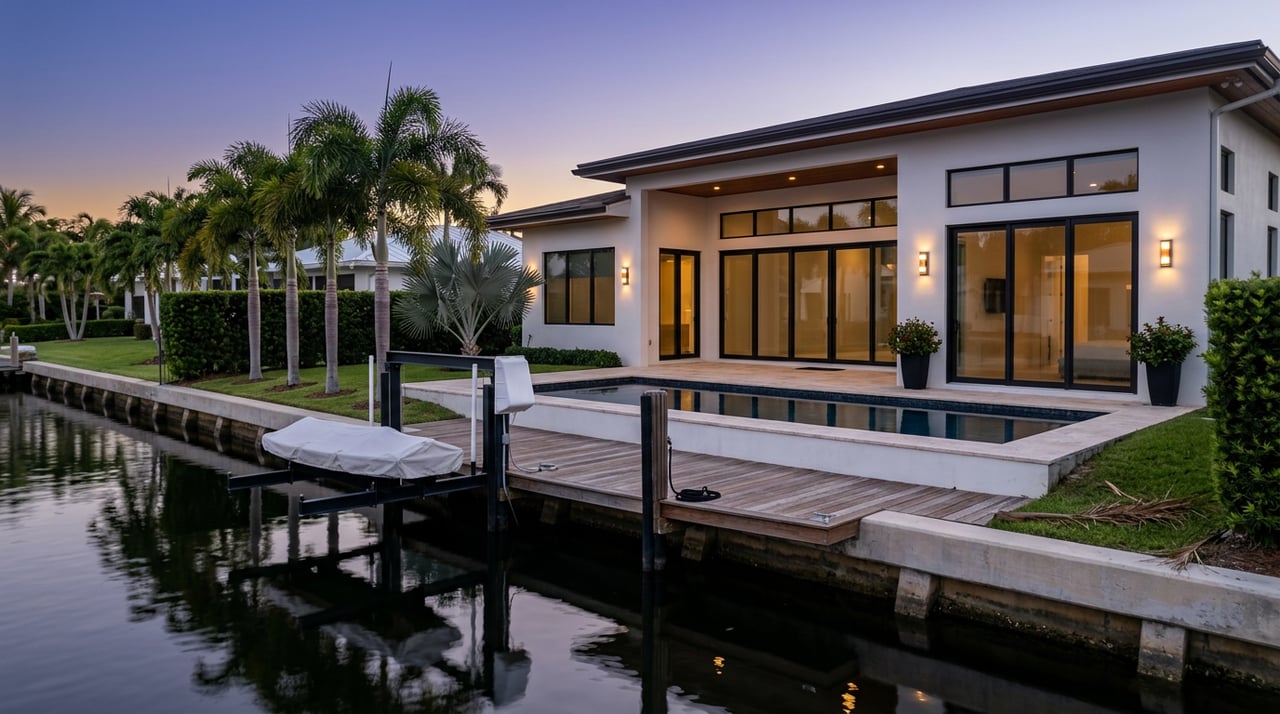
- Your own dock. No ticket, no parking, and you catch the parade earlier in its route than anyone waiting further north. The tradeoff is that once the bridge locks open, your own boat isn't going anywhere by water until the parade clears.
- Las Olas Intracoastal Promenade Park. The official ticketed viewing area, at the southeast corner of Las Olas Boulevard and the Intracoastal. Gates open at 4 p.m., tickets run $40 for adults and $35 for children 10 and under, and the parade is expected to reach the viewing area around 6:30 p.m. Parking at the adjacent Las Olas Parking Garage is described by organizers as very limited on parade night, which matters if that garage is normally part of your routine.
- The Riverside Hotel. A historic property on Las Olas Boulevard that hosts several hundred community leaders and event sponsors for the evening, with river views close to where the parade first enters open water.
- Hyatt Centric Las Olas. A more contemporary option along the Intracoastal, with the speakeasy Rm. 901 upstairs for after the last boat passes.
None of these require a ticket if you already have a dock. That's worth sitting with for a moment. The isles are one of the only stretches on the entire 12-mile route where residents get a front-row seat to a parade that draws more than a million spectators most years, without leaving their own property.
A New Dinner Option Sits Right at the Chokepoint
If you'd rather watch from a table than a seawall this year, there's a newer option worth knowing about. Ocean Prime, a two-story restaurant with panoramic Intracoastal views, opened at Las Olas Marina, the rebuilt city marina next to the Las Olas Boulevard bridge. The marina itself is part of a roughly $130 million public infrastructure project the city carried out with Suntex, which added 88 slips built for vessels up to 315 feet, roughly 7,000 linear feet of new floating dock, and 2,000 feet of new seawall along a stretch that used to be a much smaller municipal facility.
What that means for parade night specifically: Ocean Prime sits at the exact spot where the bridge locks open, which makes it one of the closest sit-down dinner reservations to the point where the isles hand the parade off to the Intracoastal. It's also a new fixture for anyone on the isles who didn't have a walkable, dockable dinner option at that corner before this marina went in.
The Waterway Runs on Rules the Rest of the Year, Too
The parade is the most visible proof that the water around the isles is managed, not just scenic, but it isn't the only one. Just south of the isles sits Lake Sylvia, widely regarded as the city's best-known protected anchorage. As of January 1, 2026, Florida requires any vessel anchored for 14 or more days within a 30-day period to carry a free long-term anchoring permit from the Fish and Wildlife Conservation Commission. It's a small regulatory shift, but it's a reminder that this stretch of water isn't governed by custom alone. It has rules that change, sometimes with the calendar year, and residents who boat regularly are the ones who notice first.
That's the throughline here. Living on the Las Olas Isles means the canal outside your dock is a functioning piece of the city's waterway system, one that hosts a locked-open bridge for a few hours every December and answers to state permitting rules the rest of the year. The parade is the one night that makes that obvious to everyone. The rest of the year, it's just how the neighborhood works.
If you're already watching the fleet go by from your own seawall this December, you understand something about this neighborhood that no brochure captures. If you're weighing whether that seawall should be yours, Heather Lefka knows this stretch of water, its bridges, and its schedule well enough to walk you through what it actually means to live here. Schedule a private consultation when you're ready to talk.